
Is My Child Stuttering? A Comprehensive Parent’s Guide
Updated: Mar 11
By a Paediatric Speech Pathologist at Milestones Kids Therapy Hub
As a parent, hearing your child begin to stutter can bring up all sorts of questions. Is it just a phase? Should I step in? Will it go away on its own?
In this blog article, we will explore what we know about stuttering, what it looks like, and how you can best support your child.
What Causes Stuttering?
The truth is, no one knows for sure what causes stuttering. However, most practitioners and research agree that it often begins between the ages of three and four and may develop gradually or quite suddenly. We also know that stuttering tends to run in families, so if a parent, sibling or extended family member stutters, your child may be more likely to stutter as well.
It's important to understand that stuttering isn’t caused by poor parenting, intelligence, personality, or copying others. It’s also not a sign of anxiety or emotional difficulties (though stress or excitement can make it more noticeable). Instead, what is widely believed is that stuttering is linked to the way the brain coordinates the muscles and movements required for speech.
What Does Stuttering Sound or Look Like?
It’s important to know that because every child is unique, stuttering can manifest in various ways. However, some of the most common signs are:
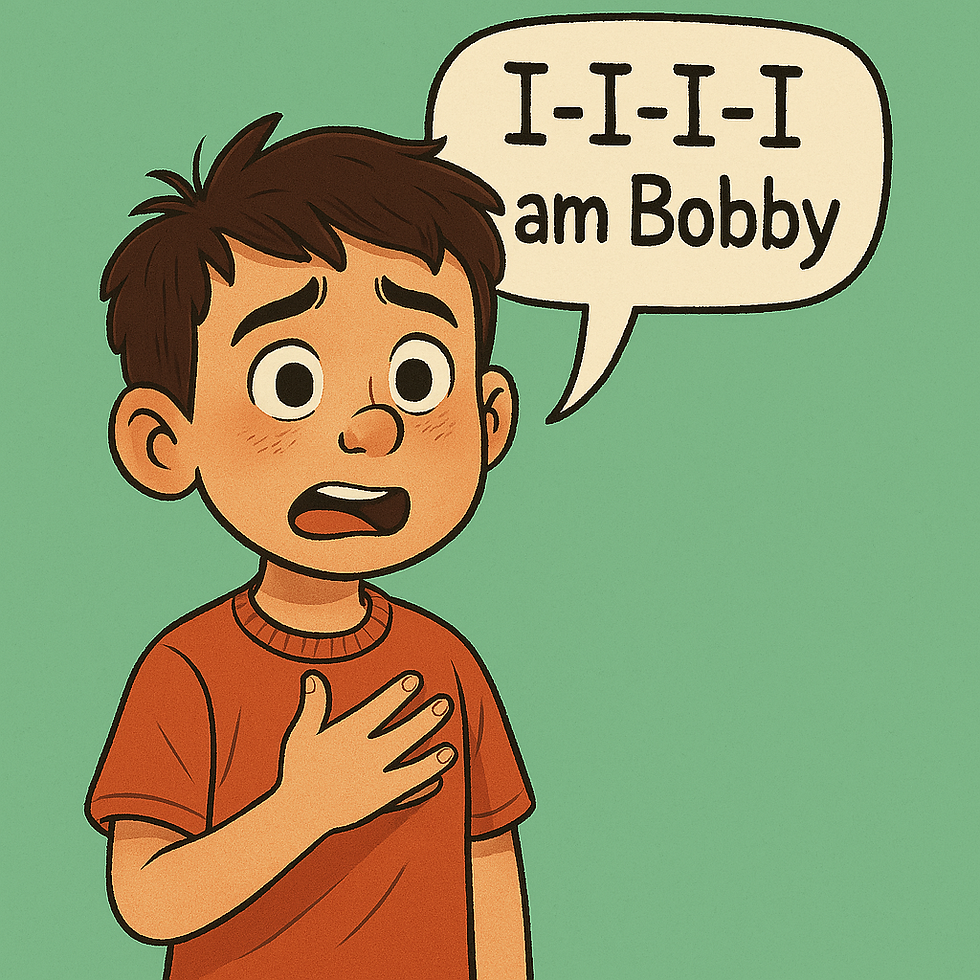
Repetition of sounds, syllables, whole words or even phrases (e.g., “I-I-I want that” or “can-can-can I?”)
Prolongation or stretching of sounds in a word (e.g., “ssssssnake”)
Blocking, where your child might try to speak but no sound comes out for a few moments—this can look like they are “stuck”
Secondary behaviours such as blinking, tension in the face or body, or other movements that accompany the stutter
These patterns might change from day to day or depending on the situation, and that unpredictability can feel confusing.
Will My Child Outgrow It?
Many young children go through a period of stuttering and then naturally overcome it. However, it’s not possible to predict which children will recover naturally and which will need additional support.
While some children’s stutters may resolve, stuttering that continues into the school-age, adolescence, or adulthood is less likely to improve without support. If it is left untreated, stuttering can impact an individual's confidence, mental health, and even participation in daily life.
That’s why early support from a speech pathologist is always the safest path forward. You don’t need to wait until it gets “bad enough.”
What Should I Do If My Child Is Stuttering?
If your child is showing signs of stuttering, here’s how you can help:
Reach out to a speech pathologist for an assessment. You don’t need to wait and see what happens. The earlier we understand what’s going on, the better we can support your child’s communication journey.
Give your child your full attention when they are speaking. Try to create moments where they don’t have to compete with the TV, siblings, or background noise.
Focus on what they are saying, not how they are saying it. This helps build confidence and connection.
Let them finish their thoughts in their own time—avoid jumping in to complete sentences or words.
Repeat back what they’ve said to show you’re listening. This can sound like “Yes, I see! You want the red one.”
Stay calm and neutral if they mention their stutter. A simple, reassuring response like “Lots of kids repeat words sometimes—it’s okay” is often enough.
Keep your interactions natural. There’s no need to change the way you talk or make comments like “slow down” or “take a breath.” These can add pressure and make your child more aware of the stutter.
What to Avoid
While your intentions may be loving, some reactions can unintentionally increase your child's pressure or discomfort. Try to steer clear of:
Pointing out your child’s stutter in front of others
Finishing their sentences
Teasing or allowing others to joke about their speech
Criticising their talking or correcting them mid-sentence
Putting them in the spotlight during speaking activities if they’re not comfortable
Instead, aim to create a safe, calm space where your child feels heard and accepted.

You're Not Alone!
At Milestones Kids Therapy Hub, we understand how important your child’s communication is to you. Our speech pathologists are experienced in working with children who stutter and can guide your family with compassion and evidence-based care.
If you’ve noticed stuttering in your child, even if it seems mild or comes and goes, we’re here to help. Early support can make a big difference in your child’s confidence and communication journey.
Get in touch today to book an assessment or to chat with one of our friendly team members.
Emily Del Principe, Speech Pathologist, Milestones Kids Therapy Hub Wetherill Park


Comments